
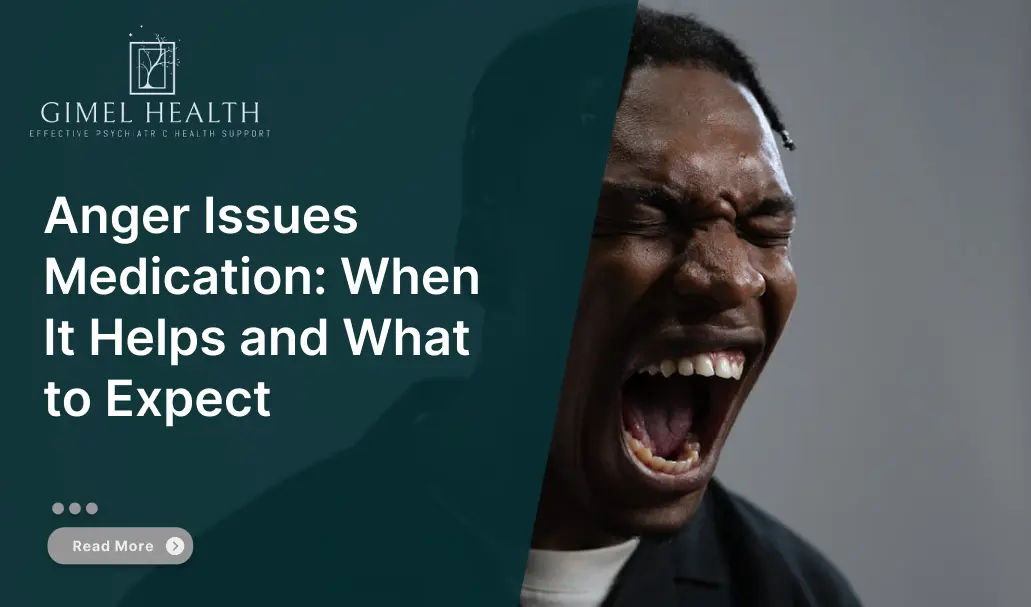
Explosive anger can damage relationships, create problems at...Read More
This guide walks through what psychiatrists actually prescribe as the best medication for anger, why no single medication works for everyone, and how the decision is made in practice. The goal is to give you a clear, clinically grounded picture of the best medication for anger before you book an evaluation, not to replace one.
When anger feels disproportionate to the trigger, when outbursts come faster than the thoughts behind them, and when the regret that follows starts to outweigh whatever caused the eruption in the first place, you are usually past the point where willpower or talk therapy alone will close the gap. Explosive anger is rarely a personality flaw. More often, it is a clinical signal of an underlying condition that responds well to the right medication.
Explosive anger is one of the most stigmatized presentations in psychiatry. It is also one of the most misunderstood. The DSM-5-TR, the diagnostic manual used by psychiatrists, recognizes Intermittent Explosive Disorder (IED) as a distinct impulse control disorder defined by recurrent, unwarranted aggressive outbursts that are out of proportion to the situation.
IED is not the only condition where explosive anger appears. Other diagnoses where intense anger is a core feature include:
The first job of any anger evaluation is figuring out which of these is driving the outbursts. The medication that helps explosive anger in IED is not the same as the medication that helps explosive anger in bipolar disorder, and prescribing without that distinction tends to produce poor results.

There is no single best medication for anger. The honest answer is that the best medication for anger depends on what is causing the outbursts, what other symptoms are present, and how you respond to treatment over the first few weeks. That said, four drug classes do most of the clinical work when prescribing the best medication for anger, and a psychiatrist will usually start with one of them based on your evaluation.
SSRIs such as fluoxetine, sertraline, and citalopram are often considered first-line for IED and for irritability tied to anxiety or depression. The evidence base for SSRIs in IED comes from controlled trials showing meaningful reductions in aggressive outbursts over 8 to 12 weeks of treatment. Fluoxetine in particular has the strongest data for IED specifically, although other SSRIs are widely used. SSRIs work by stabilizing serotonin pathways involved in impulse control and emotional reactivity. They typically take 4 to 6 weeks to reach full effect.
When explosive anger is part of bipolar disorder, mood dysregulation, or impulsivity that is not responding to SSRIs, mood stabilizers are usually the right tool. Common options include:
Mood stabilizers require regular blood monitoring, particularly lithium and valproic acid, but they are some of the most effective tools psychiatry has for severe anger problems linked to mood disorders.
At low doses, atypical antipsychotics such as risperidone, aripiprazole, or quetiapine can reduce aggression and impulsive outbursts, particularly in patients with co-occurring conditions or where rapid stabilization is needed. They are typically used when SSRIs and mood stabilizers have not produced enough improvement, or when the clinical picture includes pronounced impulsivity. Atypical antipsychotics carry side effect considerations that need careful weighing, including metabolic effects.
Propranolol is sometimes used off-label to reduce the physiological component of anger, particularly the autonomic surge (racing heart, tightness, the sense of losing control of the body) that precedes outbursts. It does not address the underlying mood or impulse pathology, but it can help in specific cases, often as an adjunct rather than a primary treatment.
If you have searched online for the best medication for anger, you have probably seen articles that list ten or fifteen drugs, group them under generic headings, and stop short of explaining how a psychiatrist actually decides between them. The list is not the treatment. The matching of medication to underlying diagnosis is what makes one option the best medication for anger in your specific case.
A few clinical realities most generic articles miss:
This is why a structured psychiatric evaluation matters more than any list of drug names. The same outburst pattern can call for very different prescriptions depending on what is underneath.
Choosing the best medication for anger is not a guessing game, but it is rarely a single decision either. The process generally moves through these stages:
A thorough assessment looks at the pattern of outbursts (frequency, triggers, severity), the surrounding mood state between episodes, sleep, energy, concentration, history of trauma, family psychiatric history, and any current substance use. Co-occurring conditions are common and change the treatment plan.
Thyroid disorders, certain neurological conditions, sleep apnea, and medication side effects can all produce or worsen explosive anger. A complete picture means looking at these before settling on a psychiatric explanation.
Once the underlying diagnosis is clear, the medication choice follows from the evidence base. SSRIs for IED. Mood stabilizers for bipolar-spectrum anger. ADHD medication when impulsivity is the driver. Atypical antipsychotics when impulsivity and rapid stabilization are needed. The best medication for anger is the one that fits the specific clinical pattern in front of the psychiatrist.
Most anger medications need to be started at a low dose and gradually increased. Side effects are monitored closely in the first few weeks. SSRIs in particular need 4 to 6 weeks to reach full effect, and patients are sometimes counseled that the first 1 to 2 weeks may include increased anxiety or irritability before improvement begins.
If a single medication does not produce enough improvement, the plan may shift to a different drug class, a higher dose, or a combination (for example, an SSRI paired with a low-dose atypical antipsychotic). This is where ongoing medication management makes the difference between a prescription and a treatment plan.

Even the best medication for anger addresses only the biological side of the problem. Therapy addresses the patterns, triggers, and skills that medication cannot teach. For most patients with chronic anger problems, the combination produces better outcomes than either approach alone.
Cognitive behavioral therapy and dialectical behavior therapy both have evidence for anger management. CBT focuses on the thoughts and interpretations that escalate emotional reactions. DBT, originally developed for emotion regulation in BPD, is particularly useful for patients whose anger involves rapid escalation and difficulty self-soothing. A psychiatrist managing your medication will often coordinate with a therapist to make sure both pieces fit together.
At Gimel Health in Fort Lee, NJ, PA-C Michael Feldman provides psychiatric evaluation and medication management for patients dealing with explosive anger, IED, bipolar-spectrum mood instability, and related conditions, with care available across New Jersey and New York. Identifying the best medication for anger in your specific case starts with a structured evaluation, not a generic prescribing template. With a clinical background built on more than 10 years in molecular and cellular biology research, his approach is grounded in the neurobiology of impulse control and serotonin pathways. If your outbursts are affecting your work, your relationships, or your sense of control, a structured evaluation is the right first step. You can request an initial consultation.
Have questions about our health solutions or need support? Reach out using the form below, and our specialized team will respond promptly to assist you.
(201) 815-4351
440 West Str, Ste 307, Fort Lee Bergen County NJ 07024
There is no single best medication for anger that works across every patient. SSRIs such as fluoxetine and sertraline have the strongest evidence for intermittent explosive disorder and irritability tied to depression or anxiety. Mood stabilizers like lithium and valproic acid are often the best medication for anger when bipolar disorder or mood dysregulation is the driver. Atypical antipsychotics may be added in more severe cases. The right choice depends on the underlying diagnosis, which is why a psychiatric evaluation matters more than any generic list.
There is no medication officially marketed as anger pills. Most medications used to treat explosive anger come from existing drug classes: antidepressants (SSRIs and SNRIs), mood stabilizers, atypical antipsychotics, and occasionally beta-blockers. SSRIs are the most commonly prescribed because of their effect on serotonin pathways involved in impulse control and emotional reactivity. The class chosen depends on what is driving the anger. Antidepressants alone are not appropriate when the underlying condition is bipolar disorder, which is one reason proper evaluation matters.
SSRIs typically take 4 to 6 weeks to reach full effect, although some improvement in irritability may appear in the first 2 to 3 weeks. Mood stabilizers can act somewhat faster on acute mood instability, particularly lithium and valproic acid in bipolar-related anger. Atypical antipsychotics often produce more rapid reductions in impulsive aggression, sometimes within days, but are usually reserved for specific clinical situations. Patience and structured follow-up matter, because dose adjustments and patience often produce results that an early switch would have prevented.
Yes, when anger is being driven by ADHD-related emotional dysregulation. Stimulant medications and non-stimulants like atomoxetine or guanfacine can reduce reactive irritability when ADHD is the underlying diagnosis. The catch is that stimulants used in the wrong context, particularly in undiagnosed bipolar disorder or active substance use, can worsen aggression. This is why a careful evaluation that distinguishes ADHD from bipolar disorder, IED, or other conditions is essential before stimulant medication is prescribed for anger or irritability.
No. Medication for anger is one part of treatment, and for many patients, therapy is equally important. Cognitive behavioral therapy and dialectical behavior therapy both have strong evidence for anger management, particularly for the cognitive patterns and emotion regulation skills that medication cannot directly teach. The most effective treatment plans usually combine medication management for the biological component with therapy for the behavioral and cognitive components, with a psychiatrist and therapist coordinating care.
It is worth a psychiatric evaluation. GPs can prescribe SSRIs and other psychiatric medications, but cases involving persistent explosive anger, treatment resistance, or unclear diagnosis benefit from specialist assessment. A psychiatrist can review what has been tried, reassess the underlying diagnosis, and adjust the treatment plan accordingly. Many patients who did not respond well to a first-line prescription do significantly better once the medication is matched more precisely to the actual clinical picture.
Explosive anger can damage relationships, create problems at...Read More
If you have been searching for OCD treatment...Read More
If you have searched for pills for anger...Read More
Roughly three-quarters of menstruating people experience some form...Read More
If you are considering a psychiatric evaluation NYC...Read More
If you grew up hearing the term “manic...Read More
We use cookies to improve your experience on our site. By using our site, you consent to cookies.
Manage your cookie preferences below:
Essential cookies enable basic functions and are necessary for the proper function of the website.
These cookies are needed for adding comments on this website.
Google reCAPTCHA helps protect websites from spam and abuse by verifying user interactions through challenges.
Google Tag Manager simplifies the management of marketing tags on your website without code changes.
Statistics cookies collect information anonymously. This information helps us understand how visitors use our website.
Vimeo is a video hosting platform for high-quality content, ideal for creators and businesses to showcase their work.
Service URL: vimeo.com (opens in a new window)
You can find more information in our Cookie Policy and Privacy Policy.

Comprehensive services are designed for each individual. Treatment of Anxiety, Depression, ADHD, Eating Disorders,
Psychosis, schizophrenia, and other psychiatric conditions.
Sign up to our newsletter