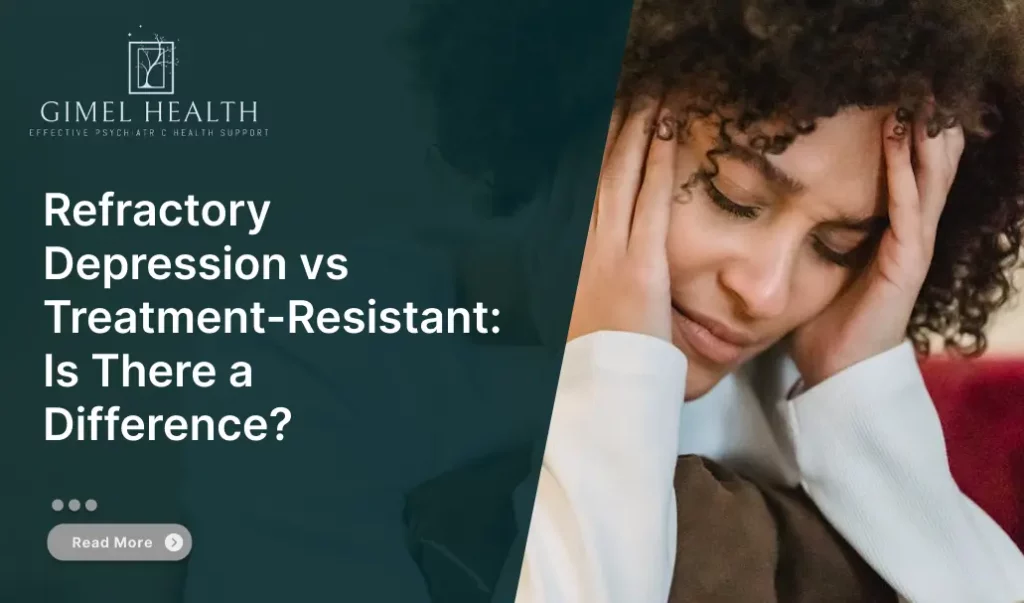
If you have been told you have refractory depression, treatment-resistant depression, or both, you have probably wondered whether the two terms mean the same thing. The honest answer is that in most clinical settings they are used interchangeably, but a more careful look reveals subtle distinctions that matter in some contexts. The label you are given does not change the underlying problem, and it does not determine your prognosis. What it does change is the treatment conversation that follows.
This article walks through how refractory depression and treatment-resistant depression are defined, where the distinctions sometimes appear in academic and clinical writing, what they have in common, and what to expect from treatment of refractory depression in current practice. The goal is to demystify the terminology and refocus attention on what actually matters: getting the right treatment for what is happening in your specific case.
The short answer on refractory depression vs treatment-resistant depression
In current clinical practice, the terms refractory depression and treatment-resistant depression (TRD) are used largely interchangeably. Both describe major depressive disorder that has not responded adequately to multiple antidepressant treatments. Most psychiatrists, primary care physicians, and mental health professionals use the two terms for the same patient population, and the choice between them often reflects personal preference or training background more than a deliberate clinical distinction.
The most widely cited working definition for both terms is the same: failure to respond adequately to at least two antidepressant trials of different pharmacologic classes, each at an adequate dose for an adequate duration. Under this definition, refractory depression and treatment-resistant depression are functionally identical, and the diagnostic and treatment approach is the same regardless of which label is used.
Refractory depression and treatment-resistant depression both affect about 30 percent of people with major depressive disorder, based on prevalence estimates from major academic medical centers including Johns Hopkins and Columbia. Both are common situations, not unusual ones. Both are highly treatable with the options now available, particularly newer interventions like esketamine, transcranial magnetic stimulation, and electroconvulsive therapy.
How “refractory depression” became a clinical term
The term refractory depression has a longer history than treatment-resistant depression. “Refractory” in medical usage generally describes a condition that resists or fails to respond to treatment. The term was used for decades to describe severe, persistent depression that did not improve with available therapies. It carried a tone of clinical severity, sometimes implying a more chronic or hopeless picture than other depression labels.
The term treatment-resistant depression emerged later as a more specific working definition. Rather than describing depression that simply “resists” treatment in some vague way, treatment-resistant depression specified the criteria: failure of two or more adequate antidepressant trials. This precision allowed researchers and clinicians to study the condition more rigorously and to develop treatments specifically for it. The FDA recognition of esketamine for “treatment-resistant depression” in 2019, for example, was made possible by the more precise definition.
Over time, the two terms converged in practice. Many clinicians use refractory depression and treatment-resistant depression interchangeably, often within the same conversation. Some prefer “refractory depression” because it sounds less judgmental than “treatment-resistant” (which can read as if the patient is resisting). Others prefer “treatment-resistant” because it is the term used in FDA labeling and clinical research. Neither preference is wrong.
Where the technical distinction sometimes appears
Despite the common interchangeability, a more careful look at the academic literature reveals contexts where refractory depression and treatment-resistant depression are distinguished.
One distinction that appears in some clinical writing reserves “refractory depression” for a more severe end of the spectrum. Under this usage, refractory depression refers to depression that has failed multiple medication trials and also brain stimulation therapies (TMS, ECT) or other advanced interventions. “Treatment-resistant depression” under this framing captures the earlier point of the journey (failure of medications), while “refractory depression” describes the further-along point (failure of medications plus advanced treatments). This distinction is not universal, and many clinicians use both terms across the full spectrum.
Another distinction involves the newer framework of “difficult-to-treat depression,” or DTD, proposed by researchers including Walter Paganin and others in recent years. The DTD framework attempts to distinguish more clearly between two situations: treatment-resistant depression as a medication-focused concept (patients who have failed adequate medication trials) and difficult-to-treat depression as a broader concept (patients whose depression has not achieved full control despite various approaches, including non-medication interventions). Under the DTD framework, “refractory depression” would belong more clearly with treatment-resistant depression as a medication-focused term, while DTD would describe the broader clinical category.
Whether these distinctions will become standard practice remains to be seen. Most current US clinicians do not draw the refractory-versus-resistant distinction in their day-to-day work, and the FDA approvals for treatments like esketamine apply to “treatment-resistant depression” specifically. For practical purposes, if you have been given either label, the next steps in treatment are essentially the same.
What both refractory depression and treatment-resistant depression have in common
Despite the terminology debate, the underlying clinical reality is consistent across both refractory depression and treatment-resistant depression.
Both describe major depressive disorder that has not responded adequately to first-line treatments. The “first-line” piece matters: a single failed antidepressant trial does not meet the criteria for either refractory depression or treatment-resistant depression. The threshold is two or more adequate trials of antidepressants from different classes.
Both require that “adequate” be carefully defined. An adequate trial means a dose at or near the maximum recommended for the medication, sustained for at least six to eight weeks. Treatments stopped early because of side effects, treatments at sub-therapeutic doses, or treatments lasting only four weeks do not count as failed adequate trials. Before accepting either a refractory depression or treatment-resistant depression label, a careful review of past trials often reveals that the previous treatment was inadequate in some way, which changes the next step.
Both occur in roughly 30 percent of major depressive disorder cases, based on STAR*D and other large studies. This is a common situation, not a rare one, and the prevalence has not meaningfully changed despite the introduction of many new antidepressants. The reason is that medication response varies significantly across individuals, and the first few antidepressants tried do not work for everyone.
Both benefit from a careful diagnostic reassessment before assuming the depression itself is the problem. Misdiagnosis (particularly missed bipolar disorder, ADHD, or trauma-related conditions), unaddressed medical conditions, substance use, and inadequate previous trials are all common causes of apparent treatment resistance that look like refractory depression but resolve when the underlying issue is addressed.
Both respond to a similar set of treatment approaches: switching antidepressant classes, augmentation strategies, brain stimulation therapies, and newer glutamatergic agents. The choice between these options depends more on the individual’s specific picture than on whether the label is “refractory” or “treatment-resistant.”

Why refractory depression is not a hopeless diagnosis
The labels “refractory depression” and “treatment-resistant depression” can feel demoralizing. Hearing that your depression is resistant or refractory can sound like a verdict, as if the medical system has given up. Neither label means that, and the treatment options now available for refractory depression are meaningfully better than what existed even a decade ago.
The clinical reality is that refractory depression is one of the most treatable serious psychiatric conditions when the right approach is taken. The challenge with refractory depression is not that depression itself becomes untreatable; it is that the first few medications tried did not happen to work for your specific neurobiology. The medications, brain stimulation therapies, and newer treatments that exist beyond first-line options work for a substantial portion of people whose initial trials failed.
The label of refractory depression should be read as a signal that your treatment approach needs to change, not that your depression cannot improve. For people who have been told they have refractory depression and feel discouraged, the more accurate framing is this: the standard antidepressants did not work, and the next step is one of the several effective options that exist for exactly this situation.
Common causes of refractory depression (and what to check before escalating)
Before escalating to advanced treatments for refractory depression, the most valuable step is often careful reassessment. Several specific causes of apparent refractory depression are common, and identifying any of them changes what should happen next.
Missed bipolar disorder is the single most common driver of what looks like refractory depression. Bipolar II disorder, in particular, is frequently misdiagnosed as unipolar major depression because the hypomanic episodes can be subtle and easy to miss. Standard antidepressants for bipolar disorder often produce poor results, partial responses that do not last, or destabilization. For someone with refractory depression who has never been carefully screened for bipolar features, the right step is often a thorough bipolar evaluation before assuming the depression itself is treatment-resistant.
Unrecognized co-occurring conditions are the second major category. ADHD, anxiety disorders, post-traumatic stress disorder, and substance use disorders all produce or worsen depressive symptoms in ways that pure antidepressant treatment cannot fully address. Addressing the co-occurring condition often produces meaningful improvement in what was labeled refractory depression.
Medical conditions can mimic refractory depression. Hypothyroidism is the most common: an underactive thyroid produces fatigue, low mood, and cognitive slowing that look identical to depression and do not respond to antidepressants. Vitamin B12 deficiency, vitamin D deficiency, sleep apnea, chronic inflammation, and chronic pain can all produce or worsen depressive symptoms.
Inadequate previous trials account for a meaningful share of refractory depression labels. Medications stopped at four weeks before the full effect developed, doses never titrated up to therapeutic levels, treatments stopped because of manageable side effects, or non-adherence in the original trial all produce what looks like refractory depression but actually reflects inadequate treatment.
Pharmacogenomic variation explains some cases. Genetic variations in the CYP450 liver enzymes that metabolize most antidepressants mean that some individuals process specific medications too quickly (preventing therapeutic levels) or too slowly (producing side effects at low doses). For someone with unusual response patterns across multiple antidepressants, pharmacogenomic testing may clarify the picture.
For a deeper walkthrough of these causes and how a thorough evaluation addresses them, see Treatment-Resistant Depression: What It Is, Causes, and New Options.

Treatment options for refractory depression
The options for refractory depression have expanded significantly over the past decade, and several represent the most meaningful change in depression treatment in a generation.
Medication strategies include switching antidepressant classes, augmentation with a second medication, and combination approaches. Switching from an SSRI to an SNRI (venlafaxine, duloxetine) or to bupropion is a common next step when the initial SSRI has not worked. Augmentation strategies add a second medication to an existing antidepressant: atypical antipsychotics (aripiprazole, brexpiprazole, cariprazine, quetiapine all hold FDA approval as MDD adjuncts), lithium, or T3 thyroid hormone. Combination approaches (SSRI plus bupropion, for example) are also common. Newer oral options for refractory depression include Auvelity (dextromethorphan and bupropion combination, FDA-approved in 2022), which works on the NMDA glutamate system.
Brain stimulation therapies are well-established options for refractory depression. Transcranial magnetic stimulation (TMS) is FDA-approved for treatment-resistant depression, requires no anesthesia, and is generally well tolerated. The course typically involves daily 30-minute sessions over four to six weeks. Newer accelerated protocols compress this into days rather than weeks. Electroconvulsive therapy (ECT) remains the most effective treatment for severe refractory depression, particularly with suicidal thoughts or psychotic features, and modern ECT is far gentler than its historical reputation suggests. Vagus nerve stimulation (VNS) is FDA-approved for chronic refractory depression but is used less commonly.
Glutamatergic agents represent the most significant pharmacological advance in depression treatment in 30 years. Esketamine (Spravato) is FDA-approved for treatment-resistant depression and provides rapid antidepressant effects (hours to days, compared to weeks for SSRIs). It is administered as a nasal spray in a healthcare setting under monitoring. Racemic IV ketamine is used off-label for refractory depression at specialized clinics. Both work on the NMDA glutamate receptor rather than the serotonin system targeted by traditional antidepressants.
Investigational and emerging treatments for refractory depression include zuranolone (Zurzuvae, FDA-approved for postpartum depression with broader applications under investigation) and psilocybin-assisted therapy (in late-stage clinical trials with FDA breakthrough therapy designation, not yet FDA-approved).
Gimel Health offers integrated treatment for resistant depression that incorporates evidence-based medication strategies and coordination with brain stimulation therapies where appropriate.
When to seek specialist care for refractory depression
The right time to seek specialist care for refractory depression is when standard treatment from a primary care or general mental health provider has not produced adequate improvement. Specific signs that escalation is appropriate include failure of two or more adequate antidepressant trials, persistent severe symptoms that affect daily function, any history of suicidal thoughts during the current episode, diminishing response to a medication that previously worked, or emerging features that suggest a different or co-occurring diagnosis.
When you bring this conversation to a psychiatric provider, several pieces of information make the evaluation more productive. A complete list of every antidepressant you have tried, the maximum dose you reached on each, how long you stayed on each, why you stopped, and whether you experienced partial or no response. Any history of unusually elevated mood, energy, or impulsivity that might indicate bipolar features. Current medical conditions and medications. Recent labs (thyroid, B12, vitamin D) if available.
At Gimel Health, my initial consultation for someone with refractory depression is 50 minutes specifically because the reassessment matters more than rushing to the next medication. Many patients labeled as having refractory depression have either a missed diagnosis or an inadequate previous treatment, and a careful evaluation produces a better plan than escalating treatment without that step.
When to take the next step
Refractory depression is one of the most common but least well-served situations in psychiatric care. The frustration of multiple failed treatments can make it feel like nothing will work, which is not accurate. The treatment options available now for refractory depression (newer medications, augmentation strategies, brain stimulation therapies, glutamate-targeting agents) work for many people whose previous treatment failed.
I provide precision psychiatry and medication management for patients in New Jersey (in-person at Fort Lee) and New York (telehealth), with specialized focus on treatment-resistant and refractory depression. Initial consultations are 50 minutes and include a careful review of your treatment history, screening for the conditions that often produce apparent treatment resistance, and a plan for the next step based on what your specific picture shows.
For trusted general reference on refractory depression and treatment options, the National Institute of Mental Health maintains current information.