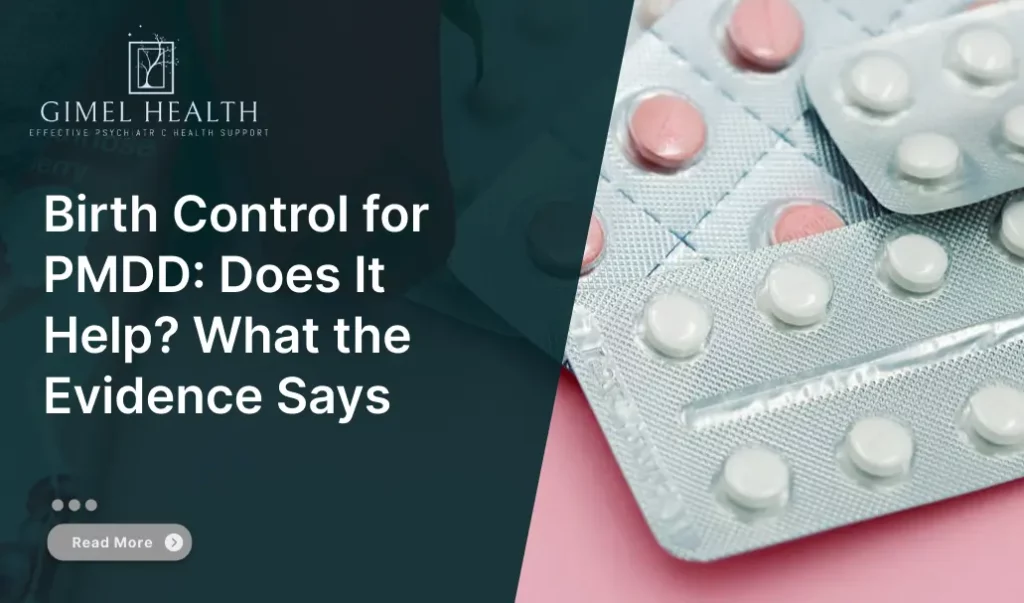
If you have PMDD, you have probably been told at some point that birth control for PMDD might help. The advice is everywhere: in the doctor’s office, in support forums, in articles. What does not get said as often is that birth control helps some people with PMDD significantly, makes some people worse, and produces only partial relief for many. The choice between hormonal contraception, an SSRI, or both is more individual than most online resources suggest.
This article walks through what the evidence actually shows. Which formulation has FDA approval for PMDD, how to think about continuous versus cyclic dosing, who should be cautious about hormonal contraception, and how to weigh birth control against the alternatives.
The short answer on birth control and PMDD
Some hormonal birth control helps PMDD. One specific formulation (a combined oral contraceptive containing drospirenone and ethinyl estradiol, marketed as Yaz) holds FDA approval specifically for PMDD. The mechanism is straightforward: PMDD is triggered by cyclical hormonal shifts, and birth control that suppresses ovulation can suppress those shifts.
The honest part of the picture: research suggests fewer than 40 percent of people with PMDD respond fully to hormonal birth control alone. For severe PMDD, partial response is common, which is why many treatment plans combine birth control with an SSRI rather than relying on either alone. Some people with a history of mood worsening on hormonal contraception will have the same response again, which makes birth control a poor first choice for them.
The decision benefits from a clinician who will track your response over the first two to three cycles and adjust the plan based on what is actually working. The rest of this article unpacks the specifics.

How birth control is supposed to work for PMDD
PMDD is not the result of abnormal hormone levels. Estrogen and progesterone fluctuate normally across the menstrual cycle in people with PMDD, just as they do in people without it. What differs is the brain’s response to those normal fluctuations.
Two mechanisms have the strongest evidence. The first involves a metabolite of progesterone called allopregnanolone, which normally has a calming effect on the brain through GABA-A receptors. In people with PMDD, this calming effect appears disrupted, producing anxiety, irritability, and emotional volatility instead. The second involves cyclical changes in serotonin function, which appear more reactive in people with PMDD.
Combined oral contraceptives interrupt this picture by suppressing ovulation. Without ovulation, the natural peaks and troughs of estrogen and progesterone flatten out, and the cyclical trigger that produces PMDD symptoms is removed. In theory, this should resolve the symptoms entirely, without needing an antidepressant at all.
The reason it does not always work is that the synthetic progestins in oral contraceptives are themselves hormones that act on the brain. Some progestins metabolize into compounds similar to allopregnanolone, which means the same brain sensitivity that triggers PMDD on a normal cycle can also be triggered by the contraceptive itself. This is why some people feel significantly better on hormonal birth control, others feel about the same, and some feel notably worse. The biology is real on both sides.
For a fuller explanation of what PMDD is and how it develops, see What Is PMDD.
Which birth control is FDA-approved for PMDD
Only one type of hormonal birth control holds FDA approval specifically for PMDD: combined oral contraceptives containing drospirenone and ethinyl estradiol. Yaz (drospirenone 3 mg + ethinyl estradiol 20 mcg) was the first to receive this indication. Beyaz is the same formulation with added folate. Generic equivalents are widely available.
Drospirenone is distinct from the progestins in most other combined oral contraceptives. It has anti-androgenic properties (which can help with acne and unwanted hair) and anti-mineralocorticoid properties (which reduce water retention and bloating). For PMDD specifically, the most important feature may be its 24/4 dosing schedule: 24 days of active pills followed by 4 days of placebo, compared to the standard 21/7 schedule used by older formulations. The shorter placebo interval means less time for the hormone-free state that can trigger a mini-PMDD episode each month.
Other combined oral contraceptives are commonly used off-label for PMDD. Some work; some do not. Evidence is strongest for drospirenone-containing formulations, which is why most prescribers start there unless there is a specific reason not to.
Progestin-only options (the mini-pill, hormonal IUDs like Mirena or Kyleena, the contraceptive injection Depo-Provera, and the contraceptive implant Nexplanon) have weaker evidence for PMDD. Some people do well on them; many find their mood symptoms worsen because progestin without estrogen can be destabilizing for sensitive individuals. These are not first-line options for PMDD.
Continuous versus cyclic dosing: why many providers skip the placebo week
Standard cyclic dosing of combined oral contraceptives includes a placebo week each month, during which you have a withdrawal bleed that mimics a period. For routine contraception, this schedule works fine. For PMDD, it has a specific problem: the hormone-free week reintroduces a smaller version of the cyclical shift that the pill is supposed to be preventing. Many people with PMDD report a mini-episode of PMDD symptoms during this placebo week, even though the rest of the cycle is much improved.
Continuous dosing skips the placebo week entirely. You take active pills every day, with no monthly bleed. Several variations exist: some prescribers use a 24/4 schedule (the Yaz default) which already minimizes the hormone-free interval; others use extended cycles (84 days of active pills, then a 7-day placebo week, producing four periods per year); others use fully continuous dosing (active pills indefinitely, no scheduled bleeding at all). For PMDD, the more continuous the dosing, the more completely the cyclical hormonal trigger is suppressed.
The trade-offs of continuous dosing are mostly about breakthrough bleeding. In the first three to six months, irregular spotting or breakthrough bleeding is common, which can be inconvenient but is not medically concerning. After the initial adjustment period, most people on continuous dosing develop amenorrhea (no period at all), which many people with PMDD find welcome. There is no medical reason to have a monthly withdrawal bleed if you are on continuous hormonal contraception. The bleed is a design feature of older 21/7 pills, not a health requirement.
Continuous dosing is not universally appropriate. It is a conversation to have with a prescriber who can review your specific situation and any contraindications. For someone with PMDD, however, it is often the dosing approach that produces the most complete symptom suppression.

When birth control makes PMDD worse
For a subset of people with PMDD, hormonal contraception worsens symptoms rather than improving them. Recognizing this group is important so that the wrong intervention does not delay the right one.
The strongest predictor is past response. Studies have shown that people who have previously experienced mood worsening on hormonal birth control are more likely to experience the same response on a different formulation. If you have tried a hormonal contraceptive in the past (for any reason) and noticed depression, anxiety, or significant mood changes, that history matters. It does not mean every hormonal option will affect you the same way, but it does mean a conversation about non-hormonal alternatives should come first.
Progestin-only contraception is more likely to worsen mood in PMDD than combined contraception. This includes the mini-pill, hormonal IUDs, the contraceptive injection, and the implant. The mechanism is the absence of estrogen to balance the progestin’s effects on the brain.
The first three months on any new hormonal contraception is an adjustment period. Some worsening of mood during this window can be normal and may resolve. Persistent worsening past three to four months is a signal to reconsider the choice rather than push through.
If you have a history of severe depression with suicidal thoughts, current active depression, or a recent significant depressive episode, starting hormonal contraception for PMDD is a more complicated decision. For these situations, an SSRI is usually a safer first step, with hormonal contraception added later if needed.
Birth control versus SSRIs versus combination: how to think about the choice
There is no single right answer. Several factors shape which approach makes most sense for a given person.
Do you need contraception anyway? If yes, a drospirenone-containing combined oral contraceptive is a reasonable first try. It addresses two needs at once, and the contraceptive effect is well established even when the PMDD response is partial.
Have you had mood problems on hormonal contraception in the past? If yes, an SSRI is usually the better first step. The risk of worsening PMDD by triggering the same hormonal mood response is real.
How severe is your PMDD? For mild to moderate PMDD, either birth control or an SSRI is a reasonable starting point. For severe PMDD with significant functional impairment or any history of suicidal thoughts during the luteal phase, SSRIs have the strongest and fastest evidence base and are usually the better first step.
Are you trying to conceive? Hormonal birth control is off the table. SSRIs become the medical option, with careful conversation about the specific SSRI’s safety profile during conception attempts and pregnancy.
Are you a partial responder to one approach? Many people with PMDD do well on a combination of a drospirenone-containing contraceptive plus a low-dose SSRI. The two work on different mechanisms (ovulation suppression and serotonin), and the combination can produce better symptom control than either alone for those who do not get full relief from one.
For a deeper look at the medication side of PMDD treatment, including SSRI dosing strategies, see PMDD Medication: SSRIs, Birth Control, and Other Treatments Compared.

What to expect when starting birth control for PMDD
The first two to three cycles on a new hormonal contraceptive are an adjustment period. Expect some breakthrough bleeding (particularly with continuous dosing), occasional nausea, possible breast tenderness, and a settling-in period for mood symptoms. None of this is a sign the medication is failing; it is the normal pattern of starting a hormonal medication.
Track your symptoms during this period. The Daily Record of Severity of Problems (DRSP) is the standard tool for tracking premenstrual symptoms, and using it for two to three full cycles after starting birth control gives you and your prescriber real data to judge whether it is working. Memory of how you felt three weeks ago, particularly across the luteal phase, is unreliable; daily ratings are not.
By cycle three or four, the pattern should be clearer. If your luteal-phase symptoms are significantly reduced and your daily function is better, the medication is working. If your symptoms are unchanged or worse, it is time to reassess rather than waiting indefinitely for improvement.
Side effects that warrant calling your prescriber, even after the initial adjustment period when most side effects fade, include severe headaches (particularly one-sided), chest pain, leg pain or swelling (possible blood clot symptoms), severe mood worsening, and any new neurological symptoms. Standard precautions for combined oral contraceptives apply.
When to take the next step
If you are weighing whether birth control is the right next step for your PMDD, the most useful conversation is with a clinician who will look at your full picture: symptom severity, past response to hormonal medications, reproductive plans, and any conditions that may be present alongside PMDD.
I provide precision psychiatry and medication management for patients in New Jersey (in-person at Fort Lee) and New York (telehealth). Initial consultations are 50 minutes and cover your full PMDD picture, including how birth control, SSRIs, or a combination would fit your specific situation.
For trusted general reference on PMDD treatment, the MGH Center for Women’s Mental Health maintains a high-quality clinical resource. For the broader PMDD picture, see What Is PMDD or PMDD vs PMS.